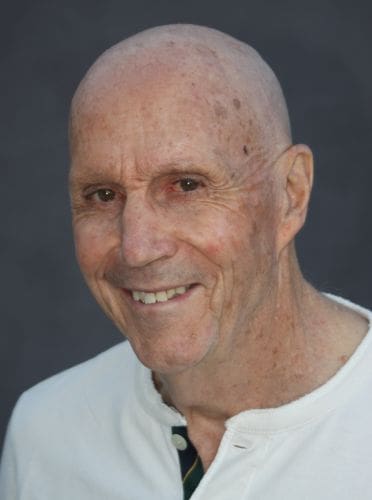
Alan Wolton (1934–2025) was born in England and began his career as a professional artist at the age of 20. Over decades of artistic development, he achieved a freedom of expression grounded in experience and the confidence of maturity.
Following international recognition, his paintings evolved toward a greater simplicity of statement. Concerns about what should or should not be gradually gave way to a more free-spirited approach. His work invited viewers to respond intuitively, beyond fixed rules or measures.
New concepts of design, sometimes incorporating minimalism, brought fresh interpretations to familiar themes. These explorations could take a moment to appreciate, yet their freshness kept collectors and admirers eagerly anticipating his next work.
Wolton spent much of his early career painting en plein air. He carried oil paints, an easel and often large canvases into the landscape, seeking to convey the truth of direct observation. Moving water frequently inspired him; rivers, rapids and the ocean remained recurring companions throughout his artistic life.
In 1975, his work took a new direction as he began painting London’s cathedrals en plein air. His canvases were limited to five feet along their longest dimension—the largest that would fit into a London taxi. These paintings appeared alongside articles he wrote for the Pitman publication The Artist.
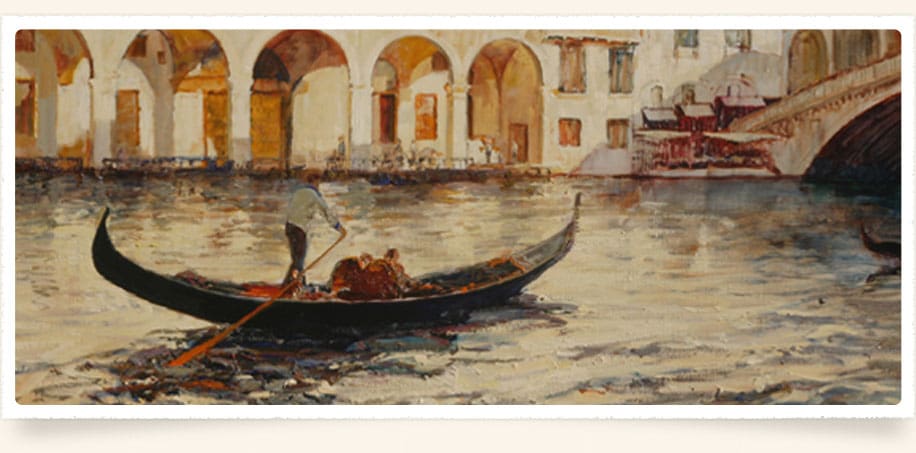
Wolton believed he could paint any subject, although he had particular favourites. Working largely in his American studio in later years, he returned frequently to water lilies and the canals of Venice, subjects that had become deeply familiar to him.
His technical command developed over a lifetime of painting, supported by an extensive history of exhibitions and professional recognition.
He typically began a canvas with a simple line drawing in paint, followed by broad areas of thin, transparent oil colour. The painting then developed through bold passages of thick impasto and highlights. A fellow artist once remarked on his ability to combine very thin and very thick paint within a single canvas.
Reflecting on his approach, Wolton said:
“I have never specifically attempted to follow a trend, the style of my work has come naturally. I choose to be a free spirit and paint with emotion. I like my paintings to stop passers-by who had only by accident caught a glimpse of the picture. What they see should be breath-takingly different, delightfully fresh, something emotionally appetizing and a joy. A little stimulation in a mundane world. A subconscious visual high spiked by a happy relationship of colors, tones, forms and cleanliness.
“Or more basically, just a happy memory. Artists are extraordinarily blessed and fortunate souls, because if their creations are effective, they give the whole world happiness.
“What more can one ask of life?”